


Packaging minimisation
Less packaging starts with needing fewer packages. Packaging minimisation sounds straight forward: use less material, make packaging lighter and reduce unnecessary space. Under the Packaging and Packaging Waste Regulation (PPWR), however, minimisation goes much further than simply reducing the amount of material used in an individual package.

Safer

Reusable

Sustainable
Packaging minimisation under the PPWR
From 2030, packaging minimisation becomes a concrete design and compliance requirement. Packaging placed on the EU market must be designed so that its weight and volume are reduced to the minimum necessary to maintain its functionality.
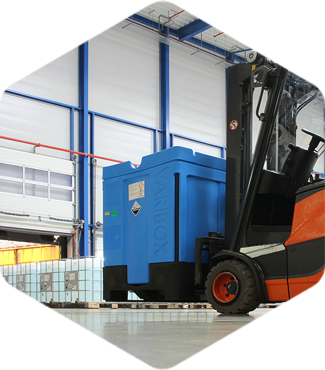
For reusable industrial packaging such as the VARIBOX IBC, this creates an interesting perspective. Minimisation starts with optimising the individual package, while reuse allows us to look at the bigger picture too: how many new packaging units does a supply chain actually need?
This fits within the broader transition towards prevention, reuse and more efficient packaging systems outlined in the VARIBOX PPWR Playbook.
What does packaging minimisation mean under the PPWR?
The central requirement can be found in Article 10 of the PPWR.
From 1 January 2030, manufacturers and importers must ensure that packaging is designed so that its weight and volume are reduced to the minimum necessary to ensure its functionality, taking into account the shape and material of the packaging.
Importantly, the PPWR does not prescribe one universal percentage by which every package must become lighter or smaller. Instead, the requirement is based on functionality.
Packaging may use the material and volume genuinely required for it to perform its job, but unnecessary weight or volume should be designed out.
This distinction is particularly important for industrial packaging. An IBC needs to safely contain its contents, withstand filling, handling and transport, protect the product and function correctly throughout its intended use. In the case of reusable packaging, the container also needs to remain suitable for repeated use.
“How light can we possibly make this container?”
The more relevant question is:
“What weight and volume does this container actually need to perform its function safely and effectively?”
How do you determine what is actually necessary?
The PPWR does not leave the definition of ‘necessary’ entirely open to interpretation. Annex IV sets out performance criteria that must be considered when assessing the minimum necessary weight and volume of packaging.
These criteria cover factors such as product protection, packaging manufacturing processes, logistics, packaging functionality, information requirements, hygiene and safety, and legal requirements.
This is important because minimisation should never come at the expense of the essential function of the packaging.
Mechanical strength
A certain amount of material may, for example, be necessary to provide mechanical strength during transportation.
Filling, handling and emptying
A particular construction may be required for safe filling, handling and emptying.
Packaging may need to withstand impacts, stacking, compression or other stresses encountered throughout the supply chain. Hygiene, safety and regulatory requirements can also determine what is necessary.
For reusable industrial packaging, durability becomes particularly relevant. A reusable container needs to be robust enough to fulfil its function repeatedly. Removing material that is necessary to achieve safe and repeated use would not represent effective minimisation.
The principle is therefore not ‘minimum possible’, but ‘minimum necessary’.
The challenge is to eliminate what is unnecessary while retaining everything required for the packaging to perform its intended function.
No unnecessary packaging just to make something look bigger
The PPWR also addresses packaging characteristics that create additional volume without serving a necessary packaging function.
Features such as false bottoms and unnecessary layers cannot simply be added to increase the perceived volume of a product when they cannot be justified against the relevant performance criteria.
This represents an important change in thinking. Every additional part of the packaging should have a reason to be there.
Marketing and consumer acceptance alone should not justify additional packaging weight or volume. There are specific exceptions within the Regulation, but the overall principle is clear: additional packaging needs a functional justification.
For industrial packaging, this reinforces the idea that design decisions should increasingly be linked to performance. If additional material, volume or a particular design feature is necessary for safety, protection, logistics or another recognised function, there is a reason for it. If it serves no necessary function, the PPWR creates pressure to eliminate it.
Empty space is part of the equation
Packaging minimisation under the PPWR does not stop at the packaging material itself. Empty space is also part of the discussion.
For grouped packaging, transport packaging and e-commerce packaging, Article 24 introduces a maximum empty-space ratio of 50 percent, subject to the implementation timeline set out in the Regulation. The intention is clear: the solution to unnecessary space should not be more packaging.
Sales packaging is also addressed. From 12 February 2028, economic operators filling sales packaging must reduce empty space to the minimum necessary to ensure the functionality of the packaging, including product protection. Where additional room or headspace is genuinely required for the packaging to function correctly, that can still be relevant, but the space needs to have a purpose.
For IBCs, headspace is more complicated
For IBCs, this gets more complicated, as the regulation for transport of dangerous goods (ADR) requires certain headspace.
In 4.1.1.4 ADR says: “When filling packagings, including IBCs and large packagings, with liquids, sufficient ullage (outage) shall be left to ensure that neither leakage nor permanent distortion of the packaging occurs as a result of an expansion of the liquid caused by temperatures likely to occur during transport.”
This maximum degree of filling is 90 to 98% of the IBC capacity, depending on the boiling point of the dangerous good.
It is important to distinguish these provisions from PPWR Article 10. Article 10 concerns minimising the weight and volume of the packaging design itself. Article 24 deals with excessive packaging and empty space in specific packaging situations.
Together, they show that minimisation under the PPWR is much broader than simply removing a few grams of material.
Reusable packaging: an important distinction
For VARIBOX, Article 24 contains a particularly relevant distinction.
Reusable packaging used within a system for reuse is exempt from the specific 50 percent maximum empty-space obligation. However, this does not mean that reusable packaging is exempt from packaging minimisation altogether.
Reusable packaging still has to comply with the applicable requirements of Article 10.
This distinction is important when discussing VARIBOX and the PPWR. It would be too strong to claim that a VARIBOX automatically complies with the PPWR packaging minimisation requirements simply because it is reusable.
Reuse does not replace the minimisation requirement. The reusable packaging itself still needs to be appropriately designed, and its weight and volume must still be justifiable based on its required functionality.
Where reuse becomes particularly interesting is in the wider question of how much packaging a supply chain needs over time.
Compliance also needs to be demonstrated
Packaging minimisation is more than a sustainability ambition. Under the PPWR, manufacturers and importers must be able to demonstrate conformity with the applicable packaging requirements.
The minimisation assessment therefore connects directly to technical documentation.
In practice, this means there should be a technical basis for why a particular weight, volume, shape or design characteristic is necessary. If additional material is needed for product protection, safe logistics, filling, repeated use, hygiene or another recognised performance criterion, that decision needs to be supportable.
This changes the nature of the minimisation discussion.
It is no longer sufficient simply to say that packaging has been ‘optimised’. Companies increasingly need to understand what is necessary for their packaging to perform its function and be able to substantiate the design decisions behind it.
For industrial packaging, this is particularly important because the lightest solution is not automatically the best or most compliant solution. Safety, durability, product protection and functionality remain essential.
Minimisation is about removing excess, not removing function.
Where reuse changes the perspective
This is where the VARIBOX story becomes especially relevant.
Consider an industrial supply chain based on single-use packaging. Every new delivery requires another packaging unit. Each individual package can be optimised: less material can be used, dimensions can be reduced and unnecessary weight can be removed.
But after that package has completed its single-use cycle, another unit is needed for the next delivery.
A reusable VARIBOX operates differently.
The same IBC is designed to circulate through multiple use cycles. Instead of continuously introducing a new single-use packaging unit into the supply chain, an existing packaging asset can be returned and used again.
This does not change the legal definition of packaging minimisation in Article 10. The PPWR does not say that reusable packaging automatically qualifies as minimised because it can replace multiple single-use units over its service life.
But reuse does introduce a second and highly relevant perspective.
With single-use packaging
With single-use packaging, the minimisation question often becomes:
“How little material can we use for each new container?”
With reusable packaging
With reusable packaging, another question becomes possible:
“How many new containers does this supply chain actually need?”
That is where the conversation moves beyond optimising a single packaging unit and towards considering packaging use across an entire supply chain.
From minimising a package to minimising packaging
Packaging minimisation and reuse are therefore not the same thing, but they can reinforce each other.
The PPWR requires companies to look critically at the individual package. Is its weight necessary? Is its volume necessary? Does every design element serve a genuine function? Is unnecessary empty space being avoided? And can those decisions be technically justified?
Reuse adds a wider system-level perspective.
One reusable VARIBOX can perform its packaging function repeatedly throughout its service life. Rather than introducing a newly produced single-use packaging unit for every cycle, the packaging remains in circulation and continues to perform the function for which it was designed.
That is an important distinction for the VARIBOX minimisation story. The argument should not be that a reusable IBC can simply be heavier because it is reusable, nor that reuse automatically guarantees compliance with Article 10. The individual VARIBOX still needs to meet the applicable minimisation requirements.
The opportunity lies in combining both ideas.
First, design the packaging so that its weight and volume are no greater than necessary to perform safely and effectively. Then, where reuse is appropriate, keep that packaging performing its function across multiple cycles instead of repeatedly replacing it with a new single-use unit.
This changes the minimisation conversation from only:
“How light can one container be?”
to the much broader question:
“How many containers does this shipment stream actually need?”
That is where reusable packaging can support the wider direction of the PPWR. Less unnecessary weight. Less unnecessary volume. Less unnecessary empty space. And through reuse, potentially fewer new packaging units entering the supply chain in the first place.
Because effective packaging minimisation is not only about making one package smaller or lighter. It is about using no more packaging than is genuinely necessary to perform the job.
Want to discuss packaging minimisation and reuse?
Explore how reusable VARIBOX IBCs can support your packaging strategy and help you assess packaging use across repeated supply-chain cycles.
Our VARIBOX Intermediate Bulk Containers
We provide packaging for chemical distribution that excels in safety, reusability, and sustainability.

VARIBOX
Single Containment


VARIBOX
Full Containment

VARIBOX
Compact Containment

VARIBOX
Drumtainer

Connect+
Full control of your IBC fleet with real time tracking and insights. Pack AI provides an intelligent solution for the reusable packaging industry comprising both hard and software that allows you to achieve maximum control, minimal loss, and a longer lifespan for your IBC fleet.