


Reuse and refill targets
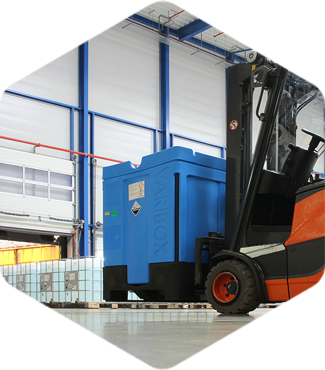
A reusable IBC system built for circular logistics, helping customers who use transport packaging prepare for the reuse targets that apply from 2030. The scope depends on how the packaging is used: a 40% target for general B2B transport, full reusability for shipments between your own sites or within the same Member State, and an exemption for dangerous-goods (ADR) lanes.

Safer

Reusable

Sustainable
Reuse and refill targets
PPWR sets binding reuse targets for transport packaging, applying from 2030. For anyone moving bulk liquids on B2B lanes, that changes the picture on whether packaging is bought once or used many times. The size of the obligation depends on how the packaging is used: it doesn’t apply the same way to every shipment, and it doesn’t land on the packaging manufacturer. This page sets out how the scope breaks down.
What the target actually requires
From 1 January 2030, economic operators that use transport packaging, including intermediate bulk containers, named explicitly in Article 29(1), must ensure at least 40% of that packaging is reusable within a re-use system. From 1 January 2040, the aim rises to 70%, though that figure is an “endeavour” obligation, not a hard target.
Two situations where it’s not 40%, but all of it
Under Article 29(2) and 29(3), the percentage disappears entirely in two specific cases: transport packaging moving between an operator’s own sites (or to a linked/partner enterprise), and transport packaging used to deliver to another economic operator within the same Member State. In both cases, PPWR requires that packaging to be reusable in full, from 1 January 2030. If most of a customer’s shipments fall into one of these two categories, the real target isn’t 40%. It’s close to all of it.
Everything else, meaning cross-border B2B transport between unrelated companies, falls under the general 40% (2030) / 70% (2040, aspirational) target.
Dangerous-goods (ADR) lanes: exempted
Article 29(4)(a) exempts transport packaging used for dangerous goods under Directive 2008/68/EC (the EU’s ADR-implementing directive) from all of the above: the 40% target, the 70% aim, and both 100% sub-obligations. Three further exemptions sit alongside it in Article 29(4): large-scale, custom-designed machinery packaging; certain flexible food-contact packaging; and cardboard boxes. Less relevant for rigid IBCs, but part of the same exemption list.
Where the target sits in PPWR
Article 29 sets the targets themselves: the 40%/70% general figures, the two 100% sub-obligations, and the exemption list. Annex VI sets the operational requirements for the re-use system delivering that target. Part A covers what every re-use system must have: a defined governance structure, a design that meets the minimum number of rotations set out in the delegated act under Article 11(2), reverse logistics and reconditioning, reporting, and extended producer responsibility for packaging that becomes waste, with separate additional rules for closed-loop versus open-loop systems. Part B covers reconditioning itself: condition assessment, cleaning and washing, repair, and a fitness-for-purpose check before the packaging goes back into use. Part C covers refill stations specifically, which is not relevant for transport packaging.
On minimum rotations specifically: Article 11(2) requires the Commission to adopt a delegated act setting the minimum number of times a unit of reusable packaging must be able to complete a reuse cycle before it counts toward the Article 29 target. That delegated act has not yet been published. Until it is, no numeric rotations figure, for VARIBOX or any packaging, can be claimed against the PPWR target itself. Durability and drop-test evidence can be shared today, but as service-life data, not as a confirmed regulatory rotations count.
Why the pressure is rising now
Reuse targets are not the only lever pushing bulk-liquid shippers toward reusable systems. PPWR also changes the cost side of single-use packaging through eco-modulated Extended Producer Responsibility (EPR) fees: less-recyclable packaging faces higher fees, on top of the documentation and reporting overhead that single-use containers carry on every shipment. A reusable IBC fleet absorbs the upfront investment across many cycles rather than stacking those costs shipment by shipment. Where the total-cost-of-ownership crossover point sits depends on shipment profile, return-logistics density, and current single-use cost, so we don’t publish a generic percentage-savings figure. We build that model together with customers who want one.
Who holds the reuse duty
Article 29 attaches the duty to “economic operators that use transport packaging”, not to packaging manufacturers as such. PPWR defines “economic operator” broadly, in Article 3(12): manufacturer, supplier, importer, distributor, authorised representative, final distributor, and fulfilment service provider. VARIBOX is a manufacturer and supplier of the container. Your organisation is the economic operator using it to transport goods. The duty in Article 29 sits with whoever is doing the using. For a VARIBOX customer shipping product in a VARIBOX IBC, that is your organisation, not VARIBOX.
A reusable system doesn’t transfer the reuse duty to the manufacturer, but it makes the duty realistic to meet.
Where VARIBOX fits
VARIBOX is a reusable IBC system designed for repeated use in closed-loop logistics: one unit, many cycles, in place of a stream of single-use packaging. That’s the practical starting point for meeting a reuse target: durability evidence (drop tests, wash-cycle data, field performance, tied to the minimum-rotations basis in Article 11(2)) and a documentation layer covering reuse cycles, cleaning logs, supplier declarations and CoCs, so the records survive an audit and support the Annex VI Part A/B requirements a re-use system has to meet. It is honest to say VARIBOX supports PPWR readiness for the reuse target. It does not carry the reuse duty for you, and it does not make the ADR-lane exemption disappear.
Frequently asked
Does buying VARIBOX mean we’re PPWR compliant on reuse?
VARIBOX gives you the two things the target actually requires: a reusable system designed for repeated cycles, and the per-unit documentation (reuse logs, cleaning records, declarations, CoCs) that a re-use system needs to hold up under audit. What it doesn’t do is take over the duty itself. Under Article 29, that stays with the economic operator using the packaging: your organisation. VARIBOX is the tool that makes the target realistic to hit; the accountability for hitting it is yours.
Does the reuse target apply if we ship dangerous goods?
Not for ADR-regulated lanes. Article 29(4)(a) exempts packaging for dangerous goods under Directive 2008/68/EC from the reuse target entirely: the 40% target, the 70% aim, and both 100% sub-obligations. For non-ADR goods, the applicable share depends on the shipment (see the scope breakdown above).
What documentation does VARIBOX provide to support a reuse claim?
Per-unit reuse-cycle logs, cleaning records, supplier declarations and certificates of conformity, and drop-test/durability data tied to the minimum-rotations basis in Article 11(2). A readiness documentation pack is planned for 2026.
Will reusable packaging reduce our EPR fees?
Not automatically, and we don’t publish generic savings percentages. EPR fees are eco-modulated (less-recyclable packaging faces higher fees), and single-use containers carry documentation and reporting costs on every shipment, while a reusable fleet amortises those costs across cycles. The actual crossover point depends on your shipment profile and return logistics; we build that model together with you, under NDA if preferred.
Glossary
Economic operator: defined in Art. 3(12) as manufacturer, supplier, importer, distributor, authorised representative, final distributor, or fulfilment service provider.
Re-use system: the operational framework (Annex VI Part A) a reusable packaging solution must meet, covering governance, minimum rotations, reverse logistics, reporting and EPR.
ADR: the European Agreement concerning the International Carriage of Dangerous Goods by Road, applied in the EU via Directive 2008/68/EC. Lanes under ADR are exempt from the Article 29 reuse target.
EPR (Extended Producer Responsibility): the funding and accountability mechanism within PPWR making producers responsible for end-of-life packaging management. Fees are eco-modulated by recyclability, not tied to reuse targets directly.
Minimum rotations: the number of reuse cycles a re-use system must be designed to achieve, to be fixed in a delegated act under Article 11(2). Not yet published, so no numeric figure can be claimed against it today.
Review your packaging fleet ahead of 2030
Get in touch to discuss your shipment profile and PPWR obligations.
Book a fleet review →Our VARIBOX Intermediate Bulk Containers
We provide packaging for chemical distribution that excels in safety, reusability, and sustainability.

VARIBOX
Single Containment


VARIBOX
Full Containment

VARIBOX
Compact Containment

VARIBOX
Drumtainer

Connect+
Full control of your IBC fleet with real time tracking and insights. Pack AI provides an intelligent solution for the reusable packaging industry comprising both hard and software that allows you to achieve maximum control, minimal loss, and a longer lifespan for your IBC fleet.